
Gallery
-
Restoration
By Queen Nzinga Maxwell, Art From My Womb Series
Medium: Menstrual blood, Chinese acrylic ink on canvas
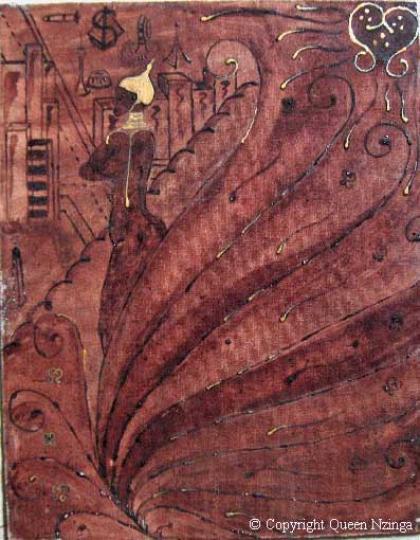
-Queen Nzinga
-
Tree with Red Skirt
Photograph by Dianne Jenett
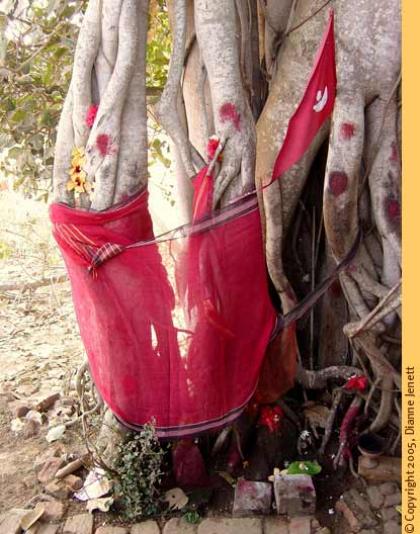
In the states of Kerala and Orissa in India, if not in other states as well, banyan trees "menstruate." I could not understand how this is, so I asked our teacher, the author Amarananda Bhairavan, who was raised in Kerala. I began with what I already knew. "I know that the rivers in Kerala were/are said to menstruate, especially as they turn red after the rainy season when they are so full, and the earth (Bhumi Devi) is said to menstruate, when Her flesh is such red earth in the hot season. But in a washerman's song from around 1910, collected by L.K. Anantha Krishna Iyer, the South Indian scholar, the banyan tree is also named as a being who menstruates. How is this true, given that the banyan is not red?" He answered that because the twining, snake-like limbs of the banyan form the shapes of little yonis all over the trunk, the people put red cum cum or other red powder in the yoni-shaped crevices to mark Her as menstrual. So it's quite intentional. "The people do it. The goddess sits right in those little crevices," he said, folding his hands to demonstrate the shape. "So then everyone knows She is sitting there, and worships Her." We wanted a photograph of such a marked banyan tree from Kerala, but couldn't find one. Dianne Jenett took a photo of a red-skirted and red-marked banyan in the state of Orissa, where the goddess who menstruates has long been revered by farming peoples and pilgrims alike.
- Judy Grahn
-
Red Flag
©1971 Judy Chicago
Medium: Photolithograph (51/94), 20"x 24," printed from aluminum plates by Sam Francis in his personal workshop, 1971.
Special thanks to the Museum of Menstruation for granting printing permission.
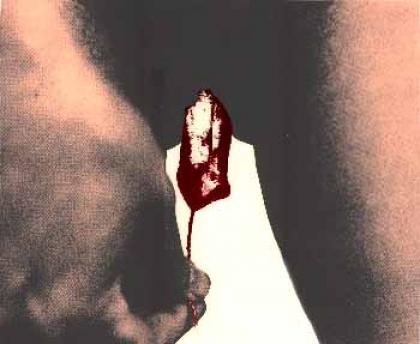
"Red Flag" portrays an everyday occurrence for many women, removing their tampon. Historically in Europe the red flag has been raised when a peoples under attack want to communicate that they will not surrender. Judy Chicago created this peice during the making of "Womanhouse", a collaborative and monumental house-sized installation of women's art. "Red Flag" had a controversial and radical effect and came as a warrior call for the feminist movement in 1971.